Wholesale buyers need more than a natural look. They need dishes that suit real service: stacks of plates, damp hands, hot food, and repeated washing. Bamboo Dishes can vary widely in construction, finish, durability, and care requirements. A product described as “bamboo” may also contain binders or coatings, so buyers should request a full material specification rather than rely on the label.
The International Bamboo and Rattan Organisation’s Global Assessment of Bamboo and Rattan (2020) estimates that bamboo forests cover more than 35 million hectares worldwide. That figure describes the resource, not the size or sustainability of the tableware market. A useful distinction. Bamboo researcher Dr. Walter Liese’s work offers a reminder for buyers: “Bamboo is a grass, not a tree.” For this guide, the purchasing takeaway is an editorial paraphrase, not a verbatim quotation from Liese: a fast-growing source does not, by itself, guarantee a responsible or durable dish. Ask suppliers about traceability, food-contact documentation, manufacturing details, and care instructions. Then compare samples under practical conditions. A plate that looks smooth under showroom lights may scratch, stain, or warp during daily use. That deserves a second look.
The ten options below focus on wholesale considerations, including product style, usability, and supplier questions. They are intended to support careful comparison, not replace product testing or documentation review. One limitation remains: supplier claims can be difficult to compare consistently. Buyers should verify them directly.
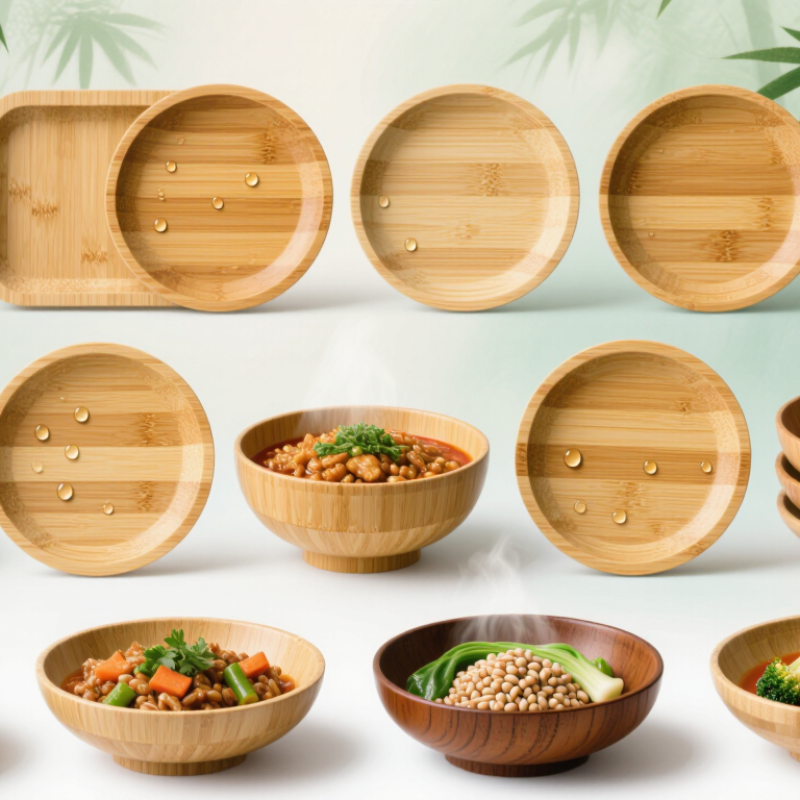
Bamboo dishes are made from different materials, not one standard recipe. Some use solid bamboo strips; others use molded bamboo pulp or bamboo powder mixed with resin. The distinction matters. A buyer should check the product’s material declaration, since a “bamboo” label alone does not reveal its full composition.
Solid bamboo dishes typically begin with mature culms cut into strips. Manufacturers remove the outer layer, dry the strips, then bond and press them into boards or shapes. The pieces are cut, sanded, and sealed for a smoother surface. Pulp dishes follow another route: bamboo fibers are separated, mixed with water, formed in molds, and pressed or dried. Powder-resin composites use a binder, so they should not be assumed to behave like plain bamboo. Not all are. Finish, bonding agent, and edge quality can vary between suppliers.
INBAR’s 2018 Global Assessment of Bamboo and Rattan estimates about 35 million hectares of bamboo forest worldwide. That figure describes the resource base, not the origin or sustainability of any specific dish. For wholesale orders, request the exact material breakdown and food-contact test documentation for the finished item. I would also inspect samples after repeated washing; a neat finish can wear sooner than expected.
Wholesale buyers should assess bamboo dishes as food-contact products, not just attractive tableware. Check whether each item is solid bamboo, bamboo fibre, or a composite, and request a full materials list. One uncomfortable point: “bamboo” on a product label tells you very little. Ask for test reports that match the dish’s intended food, temperature, and use conditions. Looks can mislead.
The FAO’s Global Forest Resources Assessment 2020 estimates that bamboo forests cover roughly 35 million hectares worldwide.
That broad supply base does not guarantee consistent quality. Ask suppliers to identify material specifications and batch controls, then compare samples for thickness, weight, rim smoothness, and stacking stability. Run a pilot. Serve hot soup and oily food, then check for warping, odour, staining, or rough edges. Follow the care instructions; a sample surviving one wash does not prove long-term durability.
For a wholesale quote, confirm dimensions, pieces per carton, packing protection, lead time, and acceptable defect rates in writing. Inspect cartons for crushed rims and uneven finishes, not only showroom samples. Request applicable food-contact documentation and verify that it covers the actual composition; generic paperwork may not. Track results across more than one production batch. This takes time, and a checklist can still miss a flaw—but it makes comparisons fairer and surprises less costly.
Bamboo dishes serve different needs, so wholesale buyers should compare shape, depth, and handling before choosing a range. Small snack plates suit samples, pastries, and counter service. Round dinner plates offer a familiar option for everyday meals. Deep plates hold noodles or saucy dishes with less spill risk. Compartment plates keep sides separate, which helps in cafeterias and children’s dining. Rice bowls work well for individual portions. Soup bowls need enough depth for broth and a steady base. Details matter.
Salad bowls give leafy portions room to toss, while mini tasting dishes suit small bites at events. Broad serving platters make shared dishes easier to present and pass. Condiment dishes keep sauces, dips, and garnishes neatly grouped. For buyers, these styles can build a practical assortment instead of a collection of similar plates. Ask suppliers about material construction, food-contact suitability, edge smoothness, and care instructions; bamboo products can vary in finish and performance. That is easy to overlook. A dish that looks sturdy in a sample may still need careful handling in daily use, so check representative pieces before ordering in volume.
Wholesale buyers should compare bamboo dishes by material, not appearance alone. Solid bamboo and bamboo-fibre composites behave differently under heat, moisture, and repeated washing.
Germany’s Federal Institute for Risk Assessment (BfR) reported in 2019 that, among tested bamboo-plastic cups, 35% exceeded the melamine migration limit and 11% exceeded the formaldehyde limit. The findings apply to the tested composite cups, not every bamboo dish. Ask suppliers for the exact material composition and independent food-contact test reports.
Durability needs evidence. Request results from repeated washing, drop, and moisture tests, then inspect samples for raised fibres, loose layers, and hairline cracks around the rim. A sample can look premium and still chip. That’s easy to miss. Confirm whether the item is intended for dishwashers, and check its stacking stability with a full load.
For design, compare weight, usable depth, smooth edges, and whether colours or finishes remain consistent across production batches. Photos rarely show these details well.
Tips: Test several pieces from the same production batch. Keep one in daily use for a week, and note stains, odours, warping, or rough spots. If the supplier cannot explain the material or care limits clearly, pause before ordering in bulk.
Wholesale buyers should assess bamboo-dish suppliers on consistency, not attractive samples alone. Request specifications for material, dimensions, thickness, moisture, and surface finish. Then compare them with production samples from several batches. Small defects matter. Check rim smoothness, odor, warping, and whether dishes stack without sticking. Ask for recent, product-specific food-contact test reports from a competent laboratory, and confirm which market requirements the reports address.
The Food and Agriculture Organization’s Global Forest Resources Assessment 2020 estimates that bamboo forests cover about 35 million hectares worldwide. That broad supply base does not guarantee traceability or uniform quality. Ask suppliers to identify bamboo origin, processing steps, and batch records. Review any sourcing claims against documents, not brochures. Be cautious when paperwork names a material but does not clearly connect it to the finished dish.
Production capacity and delivery reliability deserve equal attention. Request a written lead time, monthly output range, minimum order quantity, and packaging details. If possible, test a pilot order under realistic stacking and shipping conditions. Compare breakage, dimensional variation, and carton condition on arrival. I would still leave room for doubt: one successful sample run cannot prove every future batch will match. Set clear acceptance criteria and agree how defects, replacements, and inspection records will be handled before placing a large order.
| # | Dish Type | Typical Dimensions | Common Construction | Typical Wholesale Use | Supplier Checks |
|---|---|---|---|---|---|
| 1 | Round dinner plate | 25–28 cm diameter | Pressed bamboo fiber or laminated bamboo | Restaurants, catering, home dining, and reusable tableware collections | Confirm food-contact compliance, finish composition, dishwasher guidance, and resistance to warping. |
| 2 | Side plate | 18–21 cm diameter | Pressed bamboo fiber or laminated bamboo | Cafés, bakeries, snack service, and coordinated dinnerware sets | Check that dimensions and color match the dinner-plate range and that the rim is smooth and consistent. |
| 3 | Deep soup bowl | 14–18 cm diameter; 5–8 cm high | Pressed bamboo fiber or laminated bamboo | Soup, noodles, cereal, and casual dining | Ask for capacity in milliliters, liquid-holding test details, and care instructions for hot foods. |
| 4 | Shallow bowl | 15–20 cm diameter; 3–5 cm high | Pressed bamboo fiber or laminated bamboo | Salads, rice dishes, desserts, and food-service counters | Review usable capacity, stacking stability, and whether the surface resists staining from common foods. |
| 5 | Compartment plate | 23–27 cm across; usually 3–4 sections | Molded bamboo-fiber composite or laminated bamboo | Meal prep, school dining, catering, and portioned meals | Verify compartment layout, divider height, leak resistance between sections, and applicable food-contact documentation. |
| 6 | Oval serving platter | 30–38 cm long | Laminated bamboo or bamboo-fiber composite | Buffets, shared meals, hospitality, and retail gift sets | Check flatness, edge finish, load capacity, packaging protection, and carton dimensions for shipping. |
| 7 | Snack or dipping dish | 8–12 cm diameter | Pressed bamboo fiber or small laminated bamboo pieces | Condiments, tastings, appetizers, and add-on items for tableware sets | Confirm minimum order quantities, consistent sizing, and whether the finish is suitable for oily or acidic foods. |
| 8 | Sushi serving plate | 20–30 cm long; 10–18 cm wide | Laminated bamboo or bamboo-fiber composite | Sushi restaurants, Asian-style dining, and specialty retail | Inspect surface smoothness and finish; request care guidance and food-contact test documents for the exact product. |
| 9 | Sectioned tasting tray | 25–35 cm long; 2–5 sections | Laminated bamboo or molded bamboo-fiber composite | Sampling, shared appetizers, events, and hospitality service | Check section sizes, tray stability, finish consistency, and whether custom layouts affect tooling costs or lead time. |
| 10 | Large salad or serving bowl | 24–32 cm diameter; 8–12 cm high | Laminated bamboo or bamboo-fiber composite | Family dining, buffet service, and coordinated serving sets | Ask about usable volume, weight, stacking, and any limits on hot-food, microwave, or dishwasher use. |
Buying note: Dimensions are typical market ranges and vary by design. Bamboo-fiber tableware may contain binders or coatings; request product-specific food-contact documentation, full material details, care instructions, samples, and written quality specifications before placing a bulk order.
Call us at (516) 858-2492
for a free estimate or simply click the button below: