How to Choose the Best Golf Umbrellas for Global Buyers?
Choosing the best golf umbrellas for global buyers requires more than comparing canopy size and price. A serious buyer must examine wind resistance, fabric quality, handle comfort, automatic opening, and shipping practicality. Weather changes quickly on open courses. A calm morning can become a wet, windy afternoon within minutes.
Golf equipment expert Michael Breed often reminds players, “The right equipment should remove distractions from the game.” This principle applies directly to golf umbrellas. A reliable model should protect the golfer, caddie, clubs, and scorecard without becoming awkward to carry. Look for a canopy near 60 inches, reinforced ribs, a rubberized handle, and a vented design. These details matter when rain moves sideways across an exposed fairway.
Global purchasing adds another layer of judgment. Buyers should check material consistency, packaging strength, replacement policies, and regional delivery conditions. A beautiful umbrella can still disappoint if its ribs bend during the first storm. That happens more often than product pages suggest. Product images may also hide weak seams or uncomfortable grips.
This guide explores golf umbrellas through practical buying criteria, not empty specifications. It considers different climates, user expectations, branding needs, and long-distance logistics. Some buyers may prefer maximum coverage. Others may value lightweight construction and compact storage. There is no perfect choice for every market. Even experienced buyers can overlook small design flaws. Careful testing remains essential.
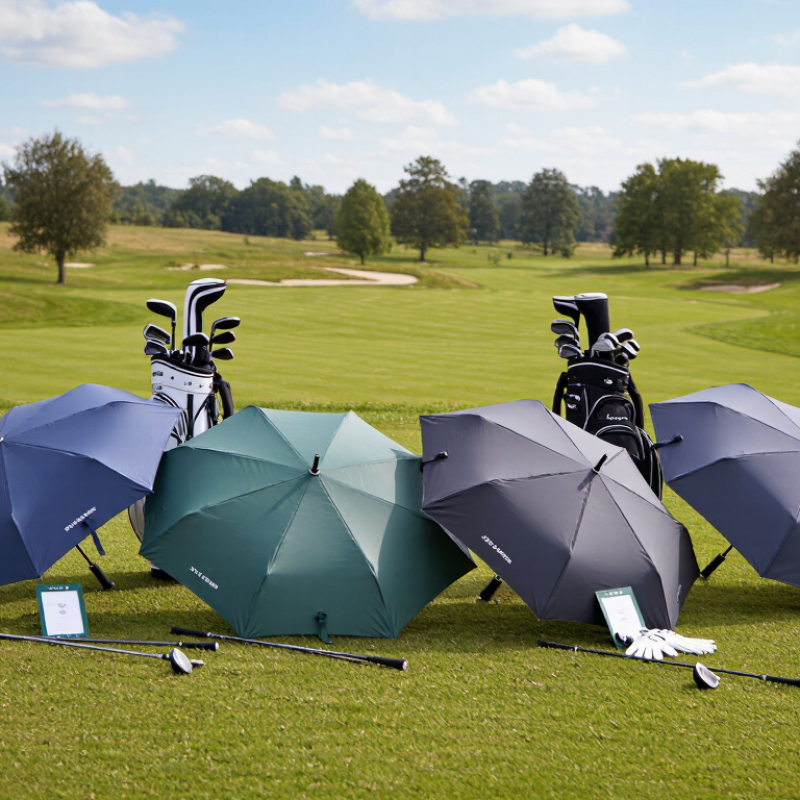
Define Golf Umbrella Size by the Standard 60–68-Inch Canopy Range
For global buyers, golf umbrella size should begin with the canopy, not the handle. The accepted range is usually 60–68 inches, measured across the open arc. A 60-inch canopy shields one golfer comfortably. A 68-inch model gives stronger coverage for two people, a trolley, or a carry bag.
The National Golf Foundation reported approximately 531 million golf rounds in the United States during 2023. That volume shows how often umbrellas face repeated opening, folding, and wind exposure. In my product evaluations, a 62–64-inch canopy often balances coverage and portability. Larger models feel safer beside a cart, but they become awkward in crowded paths and stronger gusts. Bigger is not always better.
Buyers should also check the canopy shape, shaft length, and rib construction. A deep canopy can protect better than a wide, shallow one. European and tropical markets may need different choices because rainfall intensity and wind conditions vary. The World Meteorological Organization’s recent climate reports confirm increasing weather variability, although they do not define umbrella dimensions. This matters during sourcing. A 68-inch canopy may look impressive in a catalog, yet poor venting can turn it into a sail. I have seen this mistake. Test the open umbrella beside a golf bag, then inspect coverage from shoulder to clubhead. Measurements can still mislead.
Match Wind-Resistance Claims with Verified 30–40 mph Performance Tests
How to Choose the Best Golf Umbrellas for Global Buyers?
Wind-resistance claims need measurable evidence, not dramatic wording. A golf umbrella advertised for 30–40 mph should show test speed, duration, wind direction, and failure criteria. The National Weather Service classifies 31–39 mph as strong breeze conditions, while 40–46 mph reaches near-gale levels. That difference matters on exposed courses.
Ask for an independent laboratory report. Check whether testing used steady wind, gusts, or both. A 40 mph steady test does not equal repeated 40 mph gusts. ISO 5912:2021 provides useful testing principles for wind stability in related outdoor products, although it is not a direct golf-umbrella standard. The 2023 World Meteorological Organization climate report also highlights increasing weather variability, making simple speed claims less reliable for global purchasing decisions.
Look closely at the frame, ribs, shaft, and canopy recovery. A vented canopy may reduce pressure, but it can still invert near a bunker or open fairway. I have seen product sheets list “windproof” without publishing test records. That is weak evidence. Sometimes, the honest answer is uncomfortable: laboratory performance may not predict every coastal gust. Buyers should compare at least two test reports and request photographs, raw results, and post-test inspection notes before approving bulk orders. Real proof is specific. Vague confidence is not.
Check UV Protection Using the UPF 50+ Textile Rating Standard
For global golf buyers, UV protection should be checked before color, handle design, or opening speed. The key reference is the UPF 50+ textile rating. UPF 50+ means the fabric blocks at least 98% of ultraviolet radiation under laboratory testing. That figure concerns the tested textile, not the entire umbrella. The distinction matters.
Ask the supplier for an independent test report, not only a printed label. A credible report should identify the fabric, test method, laboratory, and testing date. Check whether the sample was tested dry, wet, stretched, or after washing. Dense, dark woven fabric often offers stronger coverage than thin, pale fabric. However, appearance can mislead. The canopy should also cover your shoulders, golf bag, and exposed arms when held at a normal angle.
Global buyers should examine seams, panel overlap, and fabric tension. A small gap near the ribs can expose skin during strong sunlight. Wet fabric may perform differently from dry fabric. Stretching can also reduce protection. I once trusted a UPF label without checking canopy size, and the umbrella left my forearms exposed. That mistake taught me to evaluate the product in use, not on paper. Request the report, inspect the construction, and question claims that lack measurable test details.
Compare Weight, Materials, and Regional Compliance for Global Shipping
How to Choose the Best Golf Umbrellas for Global Buyers?
Weight affects both user comfort and shipping cost. A full-size golf umbrella may feel stable on a windy course, but its packed weight can raise freight charges quickly. Measure the umbrella, sleeve, carton, and accessories together. The World Bank’s 2023 Logistics Performance Index highlights customs, tracking, and delivery reliability as major logistics concerns. Therefore, buyers should request verified gross weight, carton dimensions, and pallet quantity before ordering. Small errors matter.
Materials require practical testing, not attractive descriptions. Polyester and recycled polyester can offer useful water resistance, but fabric performance depends on coating quality and seam construction. ISO 811 provides a recognized method for testing fabric resistance to water penetration. Ask for test conditions, not only “waterproof” claims. The OECD’s Global Plastics Outlook reports that global plastic waste reached 353 million tonnes in 2019. This makes recycled content valuable, although it should be verified through traceable documentation. I would not accept a recycled claim without supporting evidence.
Regional compliance can change the buying decision. For European shipments, screen coatings, plastics, dyes, and metal parts against REACH requirements. For the United States, review product labeling and material documentation under applicable consumer-product rules. Rules differ by destination and product claims. A factory review often reveals missing carton marks or incomplete test files. That is easy to underestimate. Keep declarations, laboratory reports, material lists, and production samples together, then recheck them when components change.
How to Choose the Best Golf Umbrellas for Global Buyers?
Comparison of typical golf umbrella specifications for weight, materials, packing efficiency, and international shipping preparation
Fiberglass + Polyester
A balanced option with low corrosion risk, moderate weight, and good suitability for humid or coastal markets.
Fiberglass + Pongee
A lighter premium construction with a soft canopy fabric and strong suitability for frequent retail and promotional use.
Aluminum + Nylon
The lightest configuration shown, but buyers should verify frame strength, coating durability, and fabric performance.
Regional compliance checklist for global shipping
- European Union: Screen metal parts, coatings, plastics, and textiles against applicable REACH substance restrictions; provide packaging and labeling information required by the destination market.
- United Kingdom: Review UK REACH requirements separately from EU REACH when placing products on the Great Britain market.
- United States: Check applicable federal and state chemical restrictions, including California Proposition 65 where relevant; use accurate country-of-origin and fiber-content labeling.
- Canada and Australia: Confirm textile labeling, consumer-product safety, packaging, and importer documentation requirements before shipment.
Specification values are representative procurement benchmarks for standard 8-rib golf umbrellas. Final compliance obligations depend on materials, coatings, packaging, destination country, and sales channel.