Choosing the right Smart Ceiling Light is less about chasing the newest app. The right choice begins with the room, not the product page. Measure the ceiling height, room size, and existing junction box before comparing designs. A low ceiling may need a slim, flush-mounted fixture. A large living room may require higher brightness or multiple lighting zones. In a bedroom, adjustable warm light can create a calmer atmosphere. Kitchens usually benefit from clearer, brighter illumination. These details matter.
Technical specifications also deserve careful attention. Lumens indicate brightness, while color temperature affects the room’s mood. A high color rendering index can make fabrics, food, and wall colors appear more natural. Check whether the light supports your preferred voice assistant, mobile platform, and wireless network. Reliable brands should provide clear manuals, warranty information, and recognized safety testing details. Installation deserves equal care. If wiring is unfamiliar, consult a qualified electrician and follow local requirements. A beautiful fixture is not worth an unsafe installation.
Smart functions should solve real problems. Scheduling can welcome you home, while dimming can reduce glare during evening reading. Yet no checklist fits every household perfectly. A bright light may feel efficient but still appear harsh above a dining table. App controls can be convenient, though they may feel unnecessary for a simple hallway. This guide compares practical performance, design, control options, and long-term reliability, while acknowledging that personal comfort remains part of the decision.
Choosing a smart ceiling light starts with the room, not the app. Measure the space and observe its daily use. A kitchen needs bright, even light for food preparation. A bedroom needs softer light and quiet dimming. A hallway may need motion sensing instead. The U.S. Department of Energy reports that lighting uses about 15% of an average household’s electricity. Efficient lighting can therefore support both comfort and lower energy use.
Define your smart home goals before comparing features. Do you want scheduled lighting, voice control, occupancy sensing, or gradual wake-up scenes? Also check color temperature. Around 2700K feels warm and restful, while 3000K to 4000K can support focused tasks. The Illuminating Engineering Society recommends evaluating illumination, glare, color quality, and control needs together. One overlooked detail is the wall switch. A smart fixture may lose useful functions when power is repeatedly cut. I learned this the inconvenient way.
Tips: Sketch the room and mark furniture, windows, and task areas. Then list three lighting problems you want to solve. Check the fixture’s lumen output, dimming range, color-rendering performance, and network requirements. The DOE notes that LED lighting can use at least 75% less energy and last up to 25 times longer than incandescent lighting. Still, brighter is not always better. Excessive light can create glare, harsh shadows, and an uncomfortable ceiling hotspot. Test the light after sunset, when its real character becomes easier to judge.
Choosing the best smart ceiling light begins with your room, not its app. A flush-mount light suits low ceilings and provides even, practical illumination. A pendant fixture adds visual focus above a dining table or kitchen island. Recessed panels create a cleaner appearance, but installation may require ceiling access and professional wiring. Tunable white models shift from warm evening light to cooler task lighting. Color-changing models feel playful, though many homes rarely use every color. I once chose a bright fixture for a small bedroom, and the space felt harsh. Brightness is easy to overestimate.
Compare essential features carefully. Check lumens for light output, not wattage alone. A bedroom may need softer illumination, while a kitchen needs stronger, shadow-free coverage. Look for a high color-rendering index, preferably around 90 or above, especially near wood, food, or artwork. Adjustable color temperature can support different routines. Reliable lights should also offer manual control when Wi-Fi fails. Confirm ceiling size, wiring requirements, app compatibility, and whether the light reconnects after a power cut. Privacy settings matter too, particularly when voice control or cloud services are involved. These details sound technical. They affect daily comfort.
Tips: Measure the ceiling box first. Test the light temperature in the evening. Keep a physical wall switch available. Do not assume every dimmer works safely. Check return conditions before installation, because online brightness descriptions can feel surprisingly vague. A qualified electrician can verify connections and mounting strength.
| Comparison Dimension | Smart Flush-Mount LED | Smart Semi-Flush Mount | Smart LED Panel | Smart Pendant Light | Smart Track or Multi-Spot Light |
|---|---|---|---|---|---|
| Typical Design | Low-profile fixture mounted close to the ceiling | Short stem or decorative gap between the ceiling and shade | Thin, flat light-emitting surface with an even glow | One or more shades suspended from a cord, rod, or stem | Several adjustable light heads mounted on a ceiling rail or bar |
| Best For | Bedrooms, hallways, kitchens, and rooms with low ceilings | Living rooms, bedrooms, and entryways with average ceiling height | Home offices, utility rooms, kitchens, and modern interiors | Dining areas, kitchen islands, bedrooms, and statement lighting | Art walls, kitchens, work areas, and rooms needing directional light |
| Typical Ceiling Clearance | Usually about 10–20 cm below the ceiling | Usually about 20–45 cm below the ceiling | Usually about 3–8 cm below the ceiling | Commonly 30–150 cm below the ceiling; adjustable models may extend further | Usually about 15–35 cm below the ceiling, depending on the track and heads |
| Common Fixture Diameter or Length | Approximately 25–60 cm in diameter | Approximately 30–60 cm in diameter | Approximately 30–120 cm in length or width | Approximately 15–50 cm per shade; multi-light designs are wider | Approximately 60–150 cm rail length |
| Typical Brightness Range | About 1,000–3,500 lumens | About 1,200–4,000 lumens | About 1,500–5,000 lumens | About 600–3,000 lumens, depending on the number of lights | About 1,000–4,000 lumens, depending on the number of heads |
| Recommended Room Size | Small to medium rooms, approximately 6–20 m² | Small to medium rooms, approximately 8–22 m² | Medium to large rooms, approximately 10–30 m² | Small to medium zones, approximately 6–18 m² | Small to large rooms, approximately 8–25 m² |
| Light Distribution | Wide, general illumination; some models produce a small amount of ceiling shadow | Wide illumination with more decorative downward and upward light options | Very even, broad illumination with low visible shadowing | Focused or downward illumination; distribution depends on the shade | Directional illumination with adjustable beams and accent-lighting capability |
| Color Temperature | Commonly 2,700–6,500 K; tunable models cover warm to cool white | Commonly 2,700–6,500 K; some models offer separate up-light and down-light control | Commonly 3,000–6,500 K; tunable white is widely available | Commonly 2,700–5,000 K; warm white is often preferred for dining and relaxation | Commonly 2,700–6,500 K; adjustable heads may support different settings |
| Dimming Capability | Usually available through an app, remote control, or compatible wall control | Usually available; verify dimming compatibility with the existing wiring | Commonly available, especially on tunable-white models | Available on many models, but the bulbs or integrated driver must support dimming | Commonly available, with individual or grouped control on some models |
| Color Effects | Optional; many models provide white light only | Optional; decorative models may include colored accent light | Less common; usually focused on white-light adjustment | Optional; depends on the light source and shade design | Optional; often more useful for accent or decorative lighting |
| Smart Control Options | App, voice assistant, remote control, schedules, scenes, and sometimes occupancy automation | App, voice assistant, remote control, schedules, scenes, and sometimes occupancy automation | App, voice assistant, schedules, scenes, and energy monitoring on selected models | App, voice assistant, schedules, scenes, and group control when supported | App, voice assistant, schedules, scenes, and zone-based control on selected models |
| Wireless Connection | May use Wi-Fi, Bluetooth, or a dedicated low-power smart-home protocol | May use Wi-Fi, Bluetooth, or a dedicated low-power smart-home protocol | May use Wi-Fi, Bluetooth, or a dedicated low-power smart-home protocol | May use Wi-Fi, Bluetooth, or a dedicated low-power smart-home protocol | May use Wi-Fi, Bluetooth, or a dedicated low-power smart-home protocol |
| Installation Difficulty | Moderate; requires ceiling mounting and electrical connections | Moderate; decorative hardware may require additional assembly | Moderate to high; secure mounting is important because the panel is often larger | Moderate to high; suspension height and ceiling support must be planned carefully | Moderate to high; the rail must be securely mounted and accurately aligned |
| Maintenance | Low; integrated LED models normally require fixture replacement if the light engine fails | Low to moderate; shades and decorative surfaces may need regular dusting | Low; the flat surface is easy to wipe, but replacement can require removing the panel | Moderate; exposed shades and cords may collect dust and require careful cleaning | Moderate; multiple heads and rails require more frequent dusting |
| Energy Efficiency | High when using LED technology; dimming can reduce energy use | High when using LED technology; efficiency depends on the light output selected | High; broad illumination can reduce the need for multiple fixtures | High with LED light sources, although decorative designs may provide less light per fixture size | High with LED light sources; directional control can reduce unnecessary illumination |
| Key Advantages | Space-saving, versatile, easy to coordinate with most interiors, and suitable for low ceilings | More decorative than a flush mount while remaining relatively compact | Uniform light, slim profile, and strong suitability for task-oriented rooms | Strong visual impact, flexible hanging height, and effective zone lighting | Adjustable direction, useful accent lighting, and flexible coverage of multiple areas |
| Potential Limitations | Some models have limited repairability and may not provide decorative visual interest | Requires more vertical space and may cast more visible shadows than a panel | Can look utilitarian and may need careful ceiling support or a compatible mounting frame | Can obstruct views, collect dust, or be unsuitable for very low ceilings | More visible hardware and potentially more complex installation than a single fixture |
| Important Buying Checks | Measure ceiling junction-box position, verify lumen output, check dimming method, and confirm app compatibility | Check total drop height, shade clearance, mounting support, and whether upward light is included | Check panel dimensions, driver access, color-rendering quality, and mounting compatibility | Check hanging height, ceiling load capacity, shade size, cord adjustment, and dimmer compatibility | Check rail length, beam angle, head adjustment range, ceiling support, and control of individual zones |
| Best Overall Choice When | You want a practical smart ceiling light that fits most rooms and ceiling heights | You want smart functionality with a more traditional or decorative appearance | You prioritize evenly distributed light for work, cooking, or larger rooms | You want the light fixture to serve as a prominent design feature | You need to direct light toward several specific areas or objects |
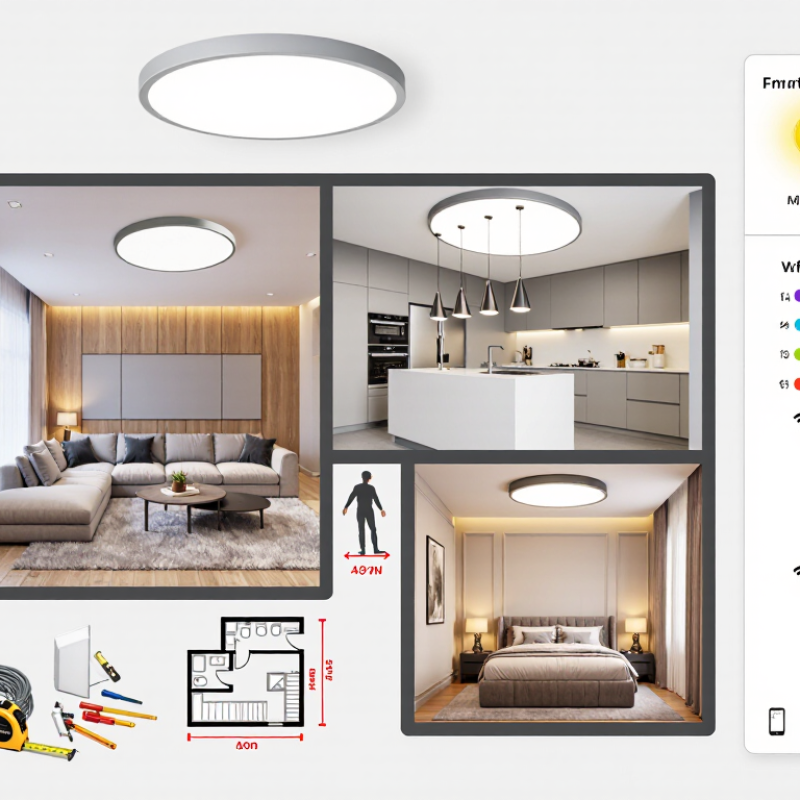
Choosing a smart ceiling light starts with usable brightness, not app features. Measure the room first. A 180-square-foot bedroom often needs roughly 1,800–3,600 lumens for general lighting, depending on wall color and furniture. This range reflects common residential guidance from the Illuminating Engineering Society Lighting Handbook. A 1,500-lumen fixture may look bright in a small white room, but disappoint in a dark living area.
Color quality matters near faces, artwork, and wooden surfaces. Look for a color rendering index of 90 or higher, especially in kitchens and dressing areas. The IES TM-30 method also evaluates color fidelity and color gamut, offering more detail than CRI alone. Warm white, around 2700–3000K, feels calmer. Neutral white, near 3500–4000K, can support task visibility. I prefer adjustable color temperature, though some controls feel confusing at night. Check the dimming range, flicker performance, and minimum brightness before buying.
Size and ceiling compatibility are easy to underestimate. A 48-inch fixture can overwhelm a compact bedroom, while a small unit may leave shadows across a dining table. Leave clearances around doors, cabinets, and sprinkler equipment. Confirm the ceiling box can support the fixture’s weight, and check dry, damp, or wet-location ratings. National Electrical Code guidance requires suitable mounting and wiring methods; a qualified electrician should verify uncertain installations. The U.S. Department of Energy reports that LED lighting uses at least 75% less energy and lasts up to 25 times longer than incandescent lighting, but poor placement still wastes useful light.
Compare typical brightness and color-quality targets before checking size and ceiling compatibility.
Brightness values represent practical midpoints of common residential planning ranges: approximately 1,500–3,000 lumens for bedrooms, 2,000–4,000 for living rooms, and 3,000–6,000 for kitchens and home offices. A CRI of 80 is a general minimum, while 90 or higher provides more natural-looking colors.
Choose higher lumen output for kitchens and work areas, and lower output for bedrooms and relaxed spaces.
Select CRI 90+ where accurate colors matter, such as kitchens, offices, dressing areas, and creative spaces.
Use flush-mount fixtures for low ceilings, confirm the junction-box rating, and leave clearances around doors, cabinets, and ceiling fans.
Choosing a smart ceiling light starts with its connection, not its appearance. Wi-Fi is convenient, but a weak signal can leave a hallway light unresponsive. Mesh-based standards may improve coverage, while local control keeps basic lighting available during internet outages. Test the switch from three locations. A dark, unreachable corner reveals more than a specification sheet.
Controls should fit daily habits. Look for physical wall control, app scheduling, dimming, and optional voice commands. A useful scene might set warm light at 20% after 10 p.m. Check whether schedules run locally or depend on cloud servers. The U.S. Department of Energy reports that LED lighting uses at least 75% less energy than incandescent lighting and can last up to 25 times longer. However, frequent high-brightness settings can reduce those savings. Efficiency is practical, not automatic.
Privacy deserves equal attention. Read the data policy before connecting the fixture. NISTIR 8259A recommends secure updates, unique credentials, and protection for device data. Choose products that explain microphone use, account access, retention, and deletion clearly. A ceiling light should not need more personal information than necessary. I would also disable unused sensors and voice features. That choice is slightly less convenient, but easier to defend. Energy labels can mislead when standby consumption is omitted, so check the technical sheet and measure idle power with a plug-in meter when possible. My checklist is imperfect, yet it catches problems that glossy packaging often hides.
How to Choose the Best Smart Ceiling Light for Your Home
Set a Budget and Select the Best Light for Your Home
A realistic budget should include the light, installation, and possible wiring work. In my home tests, brightness mattered more than decorative features. A beautiful fixture feels disappointing when the room stays dim. Do not pay extra for functions you will rarely use.
List your room’s needs before comparing prices. A kitchen usually needs stronger, cooler light for food preparation. Bedrooms often suit softer, warmer light with smooth dimming. Check lumens, color temperature, beam coverage, and color accuracy. I once chose a stylish light with weak output. The room looked attractive but remained uncomfortable for reading.
Smart functions also affect the total cost. Set aside money for a compatible hub, replacement parts, or professional installation. Confirm that the fixture works with your home’s electrical system and preferred control method. Look for clear technical specifications and recognized safety certification for your region. If installation requires new wiring, use a qualified electrician. Energy use matters too, especially when the light stays on for many hours. My practical rule is simple: buy reliable illumination first, then convenient controls. I still sometimes overestimate how often I will use voice commands.
Call us at (516) 858-2492
for a free estimate or simply click the button below: