China’s Polyester Carport supply chain spans fabric makers, frame producers, and finished-structure suppliers. For buyers, that variety creates opportunity—and a need for careful comparison. A Polyester Carport is more than a fabric canopy: its service life depends on the fabric’s coating, seam construction, frame design, anchoring, and installation quality. Small details matter. Look closely at reinforced corners, stitched or welded seams, and how the legs meet the ground.
Textile Exchange’s Materials Market Report 2024 estimates that polyester represented about 57% of global fiber production in 2023, out of approximately 124 million metric tons. This is useful context for understanding polyester’s scale as a material, but it is not a carport-market estimate. The report does not establish which supplier makes the most durable canopy. Ask manufacturers for product-specific details, including fabric weight, coating type, UV-resistance test methods, wind guidance, and warranty terms. Compare like with like.
Design matters as much as material. Architect Frank Lloyd Wright expressed a lasting principle: “Form and function should be one, joined in a spiritual union.” Applied to carports, that means matching the structure to its real use, site, and weather exposure—not choosing by appearance alone. This guide reviews China-based manufacturers and suppliers through practical buyer questions, from customization and production capability to documentation and after-sales support. Some listings may reveal gaps in public evidence. That deserves scrutiny. A polished catalogue is not proof of field performance; request verifiable specifications before deciding.
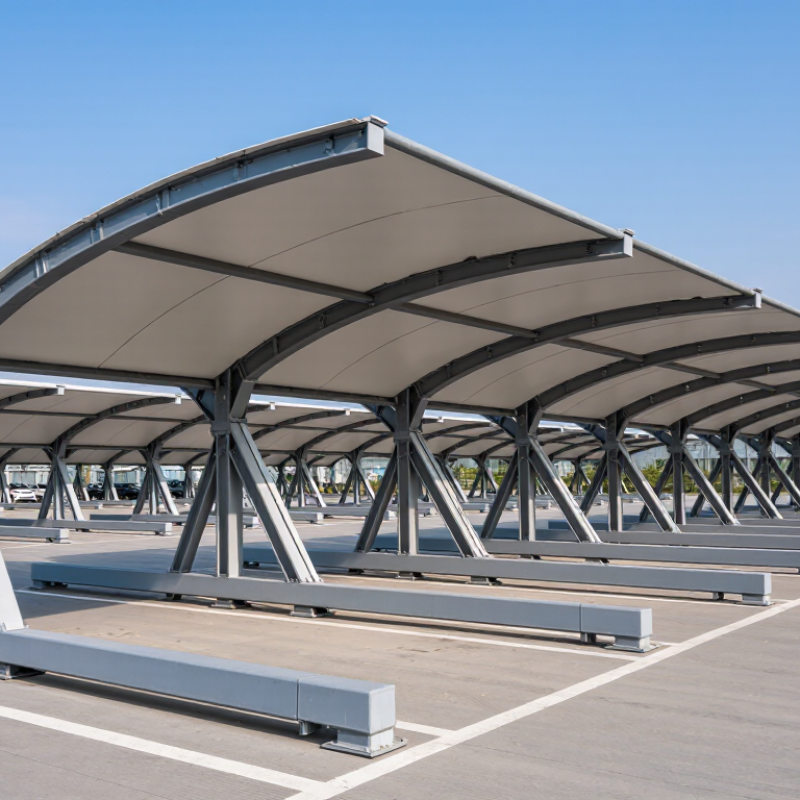
A polyester carport uses a fabric canopy stretched over a supporting frame to shade vehicles from sun, rain, and falling debris. Polyester fibers are lightweight and can be woven into durable fabric. The canopy may also receive a protective coating, such as polyurethane or PVC, to improve water resistance. Seams, stitching, and coating quality matter as much as the base fabric. Textile Exchange’s Materials Market Report 2024 estimates that polyester represented about 57% of global fiber production in 2023. That figure shows how widely used the fiber is, but it does not prove that every carport fabric performs equally well.
The frame holds the canopy above the vehicle, while anchors transfer forces into the ground. A properly tensioned cover sheds rain; sagging fabric can collect water and strain the frame. Wind resistance depends on the whole installation, including frame design, anchoring, and local exposure. Check the manufacturer’s rated wind and snow loads rather than judging strength by fabric thickness alone. Not magic. Polyester can fade or weaken with prolonged ultraviolet exposure, and a coating may wear over time. Inspect seams and anchor points after storms, and keep the canopy clear of pooled water. One often-overlooked detail is drainage direction: water should run away from doors and walkways, not toward them.
A polyester carport uses a polyester-fabric canopy supported by a frame to provide covered parking. The chart compares example footprints; coverage areas are calculated as width × length and are not market averages.
Example dimensions: 3 × 5 m, 3 × 6 m, 4 × 6 m, and 6 × 6 m. Actual dimensions and fabric specifications vary by design.
Polyester carports depend on both the fabric and the frame. The Textile Exchange Materials Market Report 2024 estimates polyester made up 57% of global fiber production in 2023. That figure describes the wider textile market, not carport fabric alone, but it shows why polyester is widely available for outdoor structures. For a canopy, buyers should check fabric weight, weave, seam quality, and protective coating. A tightly woven, UV-resistant fabric can help limit sun damage, while a water-shedding finish helps rain run off instead of pooling. Look closely at the seams. Small gaps can become leaks.
The frame carries wind and snow loads, so material choice matters. Galvanized steel offers corrosion protection, while aluminum is lighter and easier to handle. Joint fit, tube thickness, anchoring points, and clear assembly instructions deserve attention too. Ask suppliers for fabric specifications and test documentation, not just a claim of “weatherproof.” Still, thicker fabric is not automatically better; coating quality and construction affect service life. And no fabric lasts forever. In practice, inspect the roof after storms, clear standing water, and check anchors periodically. Small maintenance steps are easy to miss, especially when the carport looks fine from the driveway.
China’s polyester carport manufacturing landscape includes fabric converters, frame makers, and final assembly workshops. Some suppliers manage most steps in one facility, while others coordinate separate specialists. That difference can affect lead times and consistency.
A typical production process starts with coated polyester rolls, cut to fit roof and side panels. Workers stitch hems, reinforce corners, and add webbing where tension gathers around poles.
Small details matter. Uneven stitching may not show in a catalog photo, but it can become visible after repeated setup or wind-driven movement.
Metal frames are cut, drilled, and joined separately. Fit checks help confirm that sleeves, joints, and canopy edges align. Coating weight, seam construction, and frame thickness vary by specification, so buyers should compare samples and written measurements rather than rely on broad descriptions.
Manufacturing capacity ranges from custom, low-volume work to larger standardized runs. This flexibility is useful, but quality may vary between batches. Ask how incoming fabric is checked, whether packed units receive assembly inspections, and how replacement panels are handled.
One awkward point: samples can be better finished than routine production. Inspection records help reduce that gap, though they cannot remove every uncertainty.
Weather exposure, storage, and correct anchoring also affect service life.
When evaluating Chinese polyester carport manufacturers and suppliers, look beyond product photos. Ask for the fabric’s polyester weight, coating type, UV-resistance data, and seam construction. A clear specification sheet should identify dimensions, frame materials, and included fittings. Details matter. If answers stay vague, compare another supplier before requesting a quote.
Request a sample or inspect a finished unit, checking stitching, reinforced corners, and how the canopy attaches to the frame. Ask how test results were produced and whether they apply to the exact fabric offered. A high wind-load claim means little without test conditions. I would not treat one tidy sample as proof of consistent production; batches can differ, and that deserves scrutiny.
Review factory capacity, quality checks, lead times, packaging, and written warranty terms. Ask who handles defects and what photographs or records are needed for a claim. A video tour can show equipment, but it cannot replace independent inspection when the order is large. Compare quotations line by line, including spare parts and shipping details. I may still miss something in a supplier’s paperwork, so keep key promises in writing and verify them before payment.
| Evaluation Dimension | Weight | What to Check | Evidence to Request | Strong Evaluation Indicators |
|---|---|---|---|---|
| Fabric Specifications | 15% | Confirm the fabric construction and coating. Polyester carport covers may use polyester fabric with a PVC coating; specifications vary by product. | Written material specification stating fabric type, coating, thickness or fabric weight, color, and any stated UV or water-resistance properties. | Specifications are detailed, consistent across the quotation and product documents, and clearly distinguish tested performance from general descriptions. |
| Frame and Structural Design | 15% | Review frame material, member dimensions, joints, anchoring method, corrosion protection, and whether the design suits the intended installation site. | Drawings, bill of materials, connection details, anchoring instructions, and design information for the proposed configuration. | Structural details are provided for the actual model. Wind and snow-load suitability is supported by project-specific design information rather than an unsupported universal claim. |
| Performance Testing | 15% | Check whether performance claims for the cover or frame are supported by relevant testing. Test methods and results should match the product being quoted. | Test reports identifying the tested sample, test method, test date, results, and issuing laboratory, where applicable. | Reports are traceable and relevant to the offered materials or model. Any stated limits or test conditions are clearly disclosed. |
| Quality Management and Production Control | 12% | Assess incoming-material checks, fabric cutting and welding or stitching controls, frame fabrication checks, and final inspection procedures. | Quality-control process description, inspection checklist, sample inspection records, and details of how nonconforming products are handled. | Inspection steps and acceptance criteria are documented, and the supplier can explain how production batches are checked before dispatch. |
| Compliance and Export Documentation | 10% | Identify the regulations and documents applicable to the destination market, product type, and intended use. Requirements can differ by country and project. | Applicable declarations, test documents, product labels, packing details, and export documents relevant to the order. Verify certificates with the issuing organization when needed. | Documents match the specific product and destination. A management-system certificate, such as ISO 9001, is not by itself proof that a product meets every market requirement. |
| Customization and Technical Support | 8% | Check available dimensions, cover colors, openings, drainage options, frame configurations, and support for installation requirements. | Dimensioned drawings, a confirmed specification sheet, installation instructions, and written confirmation of custom requirements. | Changes are recorded in approved drawings or order documents before production, with responsibilities for design approval clearly stated. |
| Production Capacity and Lead Time | 8% | Confirm the production schedule, order quantity, packaging plan, and whether the stated lead time includes inspection and preparation for shipment. | Written production schedule, order milestones, packaging details, and a realistic shipment-ready date for the quoted quantity. | Lead-time commitments are specific to the order and key milestones are communicated. Capacity claims can be checked through a factory visit or third-party audit. |
| Warranty and After-Sales Support | 7% | Review warranty duration, covered parts, exclusions, claim procedure, replacement-part availability, and the buyer’s responsibilities for installation and maintenance. | Written warranty terms, after-sales contact process, spare-parts information, and maintenance guidance. | Coverage and exclusions are clear, and the response and remedy process is documented rather than relying only on verbal assurances. |
| Pricing, Payment, and Logistics | 10% | Compare the complete offer, including product configuration, packaging, tooling or customization charges, shipping terms, payment schedule, and any excluded costs. | Itemized quotation, stated Incoterms® rule and named place, packing dimensions and weight, payment terms, and estimated shipping information. | Offers are compared on the same specification and delivery basis. Costs, responsibilities, and order changes are recorded in writing. |
Scoring method: Rate each dimension from 0 to 5 (0 = no evidence, 3 = acceptable evidence, 5 = strong and verifiable evidence). Weighted score = rating ÷ 5 × weight. The total possible score is 100. Use the score as a comparison aid, not as a substitute for checking the product specification, contract, destination-market requirements, and site-specific structural needs.
Polyester carports serve homes, farms, workshops, and commercial parking areas. They can shade vehicles, protect stored equipment, or cover temporary work zones. The right design depends on more than size. Check the fabric’s coating, UV resistance, and water-shedding performance, along with frame strength and anchoring options. Local wind and snow conditions matter. A neat product sheet cannot replace a site check.
Customization may include bay width, roof height, fabric color, access openings, and frame finish. Ask suppliers for drawings and clear material specifications before production. Confirm packing details and lead times, too. After delivery, useful support includes assembly instructions, replacement-part access, and a named contact for questions. Warranty coverage should explain what is included and how claims are handled. Details vary, so compare written terms rather than relying on a quick sales promise.
Tips: Measure the site, including vehicle clearance and ground slope. Share photos if the supplier requests them. Keep spare connectors and fabric repair material on hand. Small gaps in planning can become frustrating later. I would also ask how the structure should be checked after strong winds; that practical detail is easy to overlook.
Call us at (516) 858-2492
for a free estimate or simply click the button below: